
„Japonka” and „Cymber” Trolleys in the Meat Industry: A Complete Guide to Hygiene Standards, DIN Norms and Steel Grades

Contents:
- The „Japonka” trap: from construction wheelbarrows to Food & Pharma standards
- Decoding the steels: 1.4301 or AISI 304?
- Stuffing trolleys and stainless Euro tubs — the manufacturer’s offer
- The DIN 9797 standard: your access code to automation
- The architecture of choice: type Z and type H trolleys
- Why TRACZ? The advantage of a Wrocław-based manufacturer
In the Polish food industry, the naming of transport equipment can be confusing. For a maintenance engineer, a misread enquiry can mean buying equipment that fails a HACCP audit or is incompatible with the production line. Below we deconstruct the key technical aspects of meat-industry trolleys, explaining the difference between a „Japonka” and a „Cymber” and decoding the intricacies of materials science (AISI vs. EN).
The „Japonka” trap: from construction wheelbarrows to Food & Pharma standards
The term „Japonka” is a fascinating case of B2B semantics. In the construction sector it means a two-wheeled steel or plastic wheelbarrow, widely available in DIY stores. In the meat industry, however, a „Japonka” is a specialised transport trolley for liquid raw materials, slaughter by-products or offal.
P.P.H.U. TRACZ supplies solutions made entirely of stainless steel, eliminating the risk of cross-contamination.
Why you cannot buy an „ordinary” japonka for a meat plant
- Cross-contamination risk: cheap substitutes from DIY stores carry no sanitary approvals and are not designed with hygiene in mind.
- Geometry and welding: a professional P.P.H.U. TRACZ meat-industry japonka is made of stainless steel with full-penetration welds, eliminating the crevices where bacteria could develop.
- Mechanical durability: our structures are engineered for heavy-duty use, withstanding loads that instantly deform utility wheelbarrows.
Decoding the steels: 1.4301 or AISI 304?
As a Wrocław-based manufacturer, we are often asked about the differences between steel grades. The key to understanding equipment durability is the working environment of your plant.
Standard steel: 1.4301 (equivalent to AISI 304)
This is the most popular stainless steel in the food industry. It resists water and standard detergents well; however, in contact with strong brines and chlorine-based cleaning agents it can suffer pitting corrosion.
Premium steel: 1.4401 (equivalent to AISI 316)
This is an acid-resistant grade with enhanced resistance to chlorides.
- Applications: curing, production of long-matured meats, and departments using aggressive cleaning chemistry.
- Investment: although more expensive to buy, a „Japonka” or „Cymber” made of 1.4401 (316) steel is a heavy-duty anti-corrosion solution that eliminates the need for premature equipment replacement.
A tip from the TRACZ experts: if your production line operates in a heavily salted environment, choosing 1.4401 (316) steel is the only guarantee that the trolley will not corrode after just a few months of use.
| Feature | Steel 1.4301 (AISI 304) | Steel 1.4401 (AISI 316) |
|---|---|---|
| Applications | Standard meat-processing operations | Aggressive brines, acids, chlorine |
| Corrosion resistance | High (market standard) | Very high (acid-resistant) |
| Investment cost | Optimal (standard) | Higher (heavy duty / premium) |
| TRACZ recommendation | General equipment | Specialised lines and curing rooms |
Stuffing trolleys and stainless Euro tubs — the manufacturer’s offer
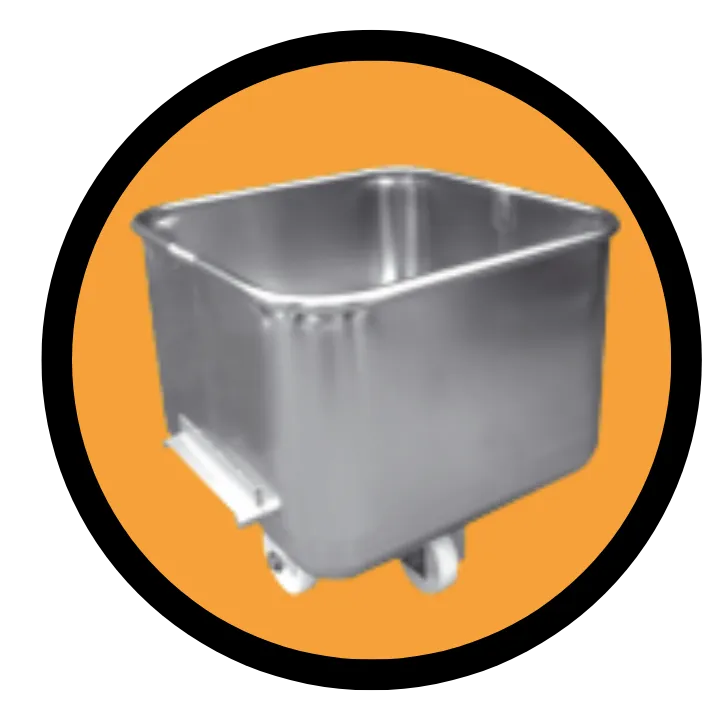 Euro tub 120 L
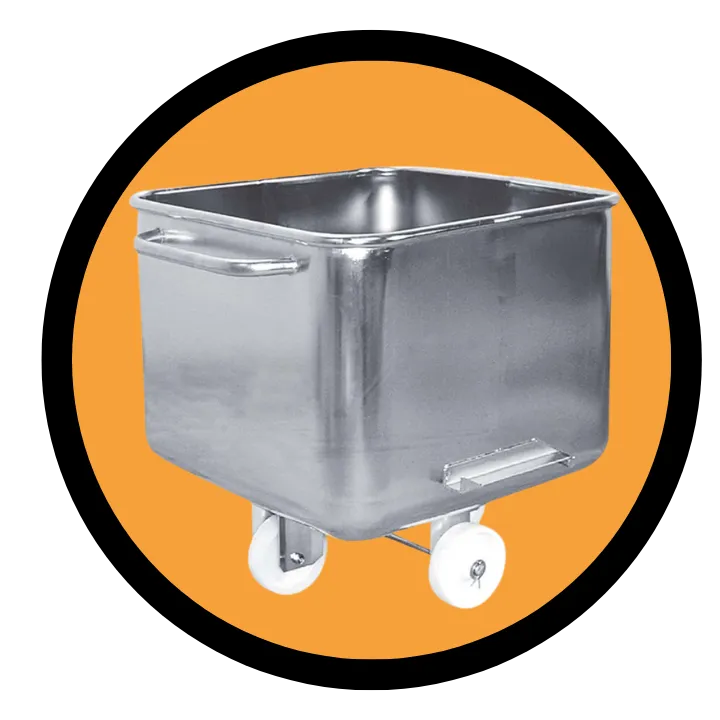 Euro tub 200 L
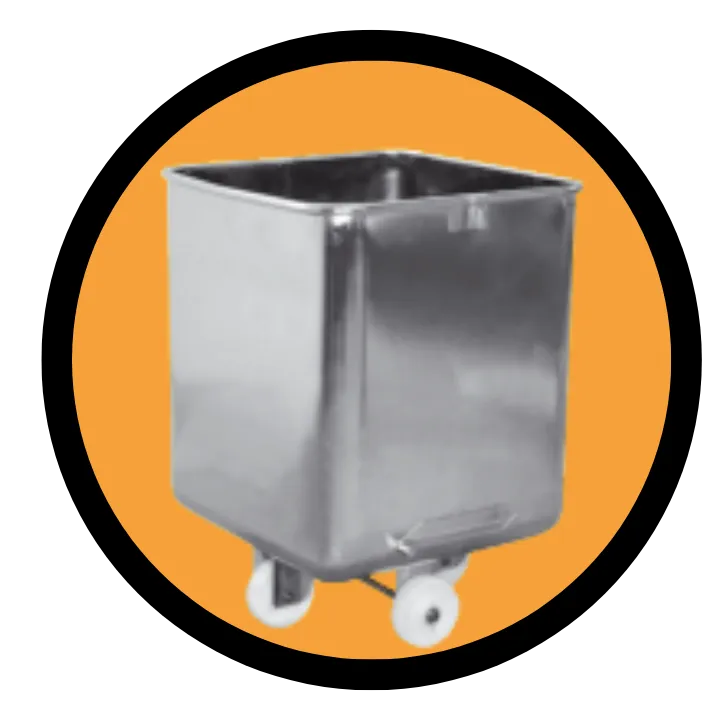 Euro tub 300 L
 Perforated Euro tub
 Euro tub, perforated special
 Euro tub 200 L with raised front wall
 Euro tub grid
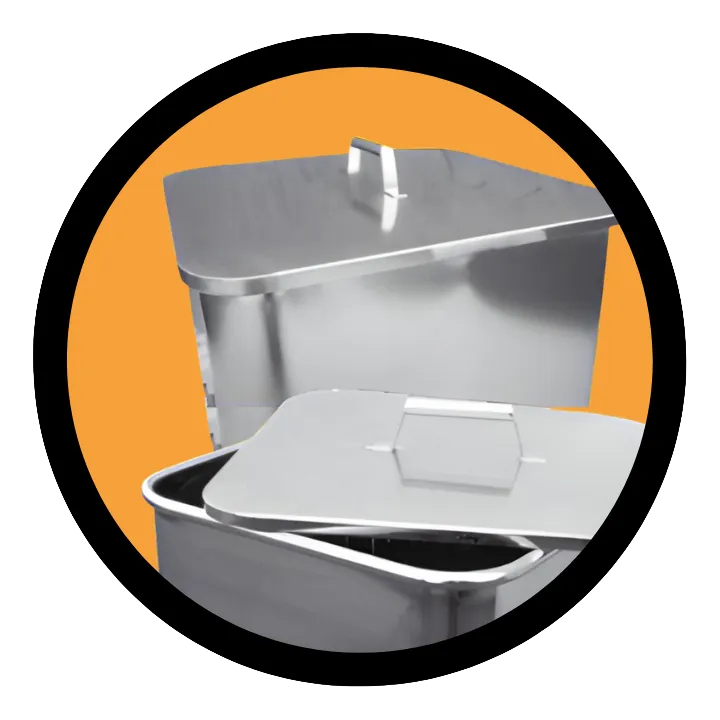 Lids for Euro tubs
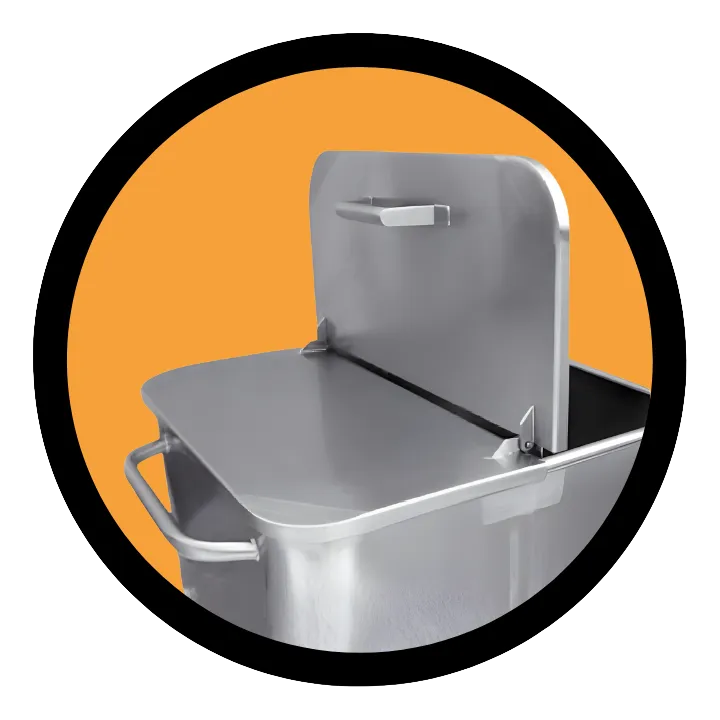 Divided lid
The DIN 9797 standard: your access code to automation
Most market offers quote DIN 9797 as a dry fact. For P.P.H.U. TRACZ it is the foundation of technological compatibility. A stuffing trolley (colloquially called a „Cymber”) with a capacity of 200 L or 300 L must meet this standard for two reasons:
- Compatibility with tipping devices: the standard determines the spacing of the wheels and side slides, guaranteeing that the trolley will fit column lifters from manufacturers such as Ekomex, Laska or Seydelmann.
- Work safety: a lack of precise fit with the lifter means the risk of a full trolley (around 200–300 kg of stuffing) falling — a critical hazard for personnel.
The architecture of choice: type Z and type H trolleys
In theory, the bigger the trolley, the fewer trips between the cutter and the stuffer. In practice, an „oversized” fleet is the shortest route to health-and-safety problems and damaged tipping devices. Efficient raw-material transport, however, is only half the battle. An equally critical stage — where every square metre of floor space and the strength of the steel count — is thermal processing. This is where the next group of equipment comes into play: smoking trolleys.
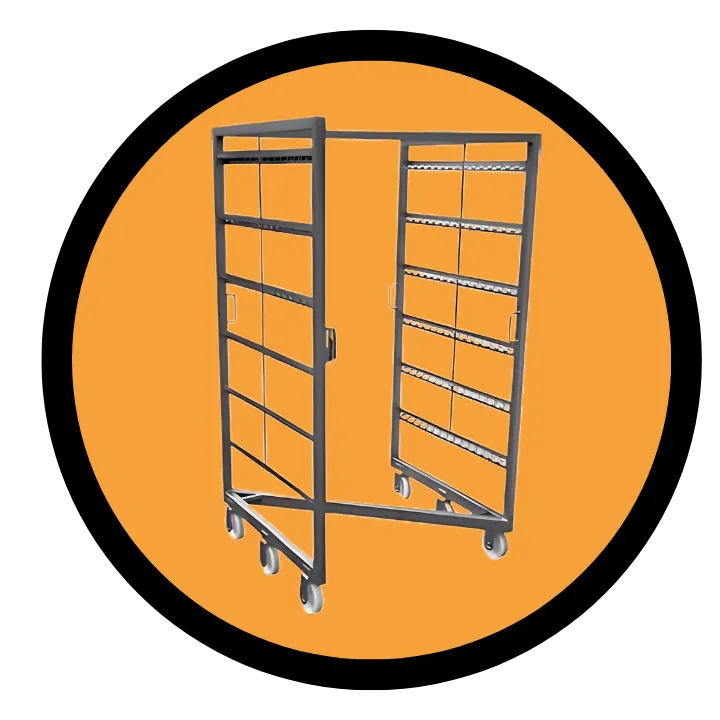
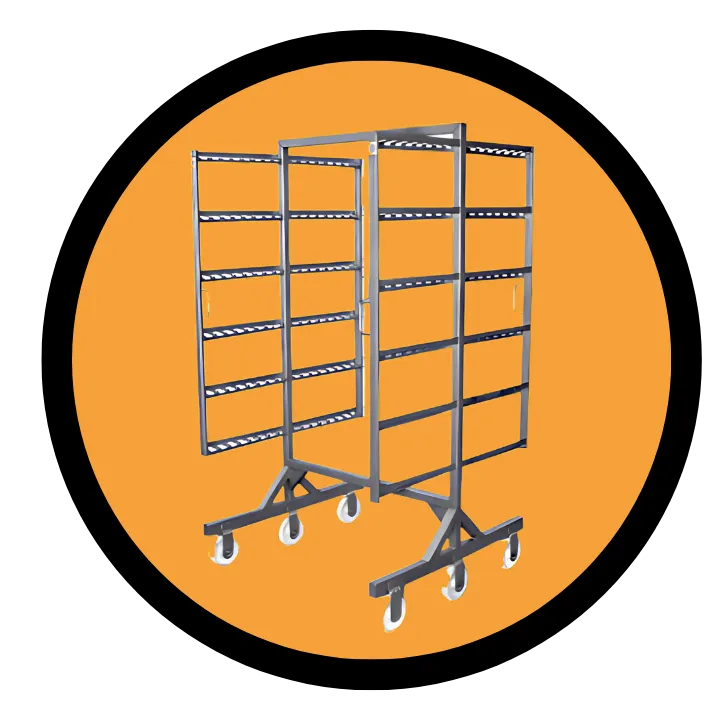
Smoking trolley type Z (the „Zetka”): allows nesting (sliding one trolley into another), saving up to 60% of storage space.
Smoking trolley type H (rigid frame): essential for the heaviest industrial loads, thanks to the increased stability and strength of the frame.
Why TRACZ? The advantage of a Wrocław-based manufacturer
Unlike resellers and online shops, P.P.H.U. TRACZ offers engineering tailored to your needs:
- Customisation: as a manufacturer, we will build a trolley for your specific production line if the standard dimensions do not fit.
- Easy access to documentation: product sheets and technical documentation are available on request — crucial for Quality Assurance audits.
- Pure B2B: we focus exclusively on the food industry and contract services. We do not make balustrades or gates — we are a specialised technology partner.
Summary for the technologist: choosing equipment is a decision about production continuity. Do not risk buying a no-name product from a DIY store. Choose engineering precision, 1.4401 (316) steel where your environment demands it, and Polish production compliant with DIN 9797.
Not sure which steel grade suits your process? Contact our sales team in Wrocław — we will match the material and design to the specifics of your production.


