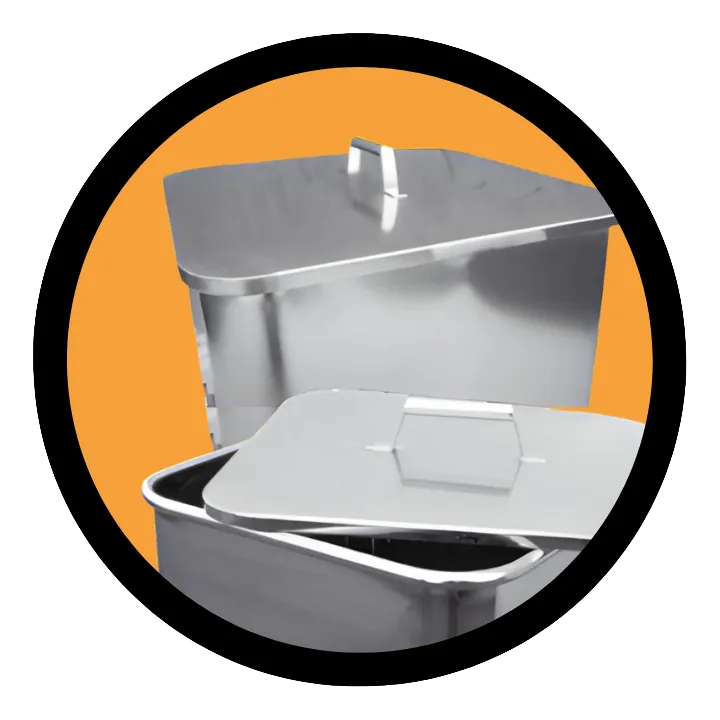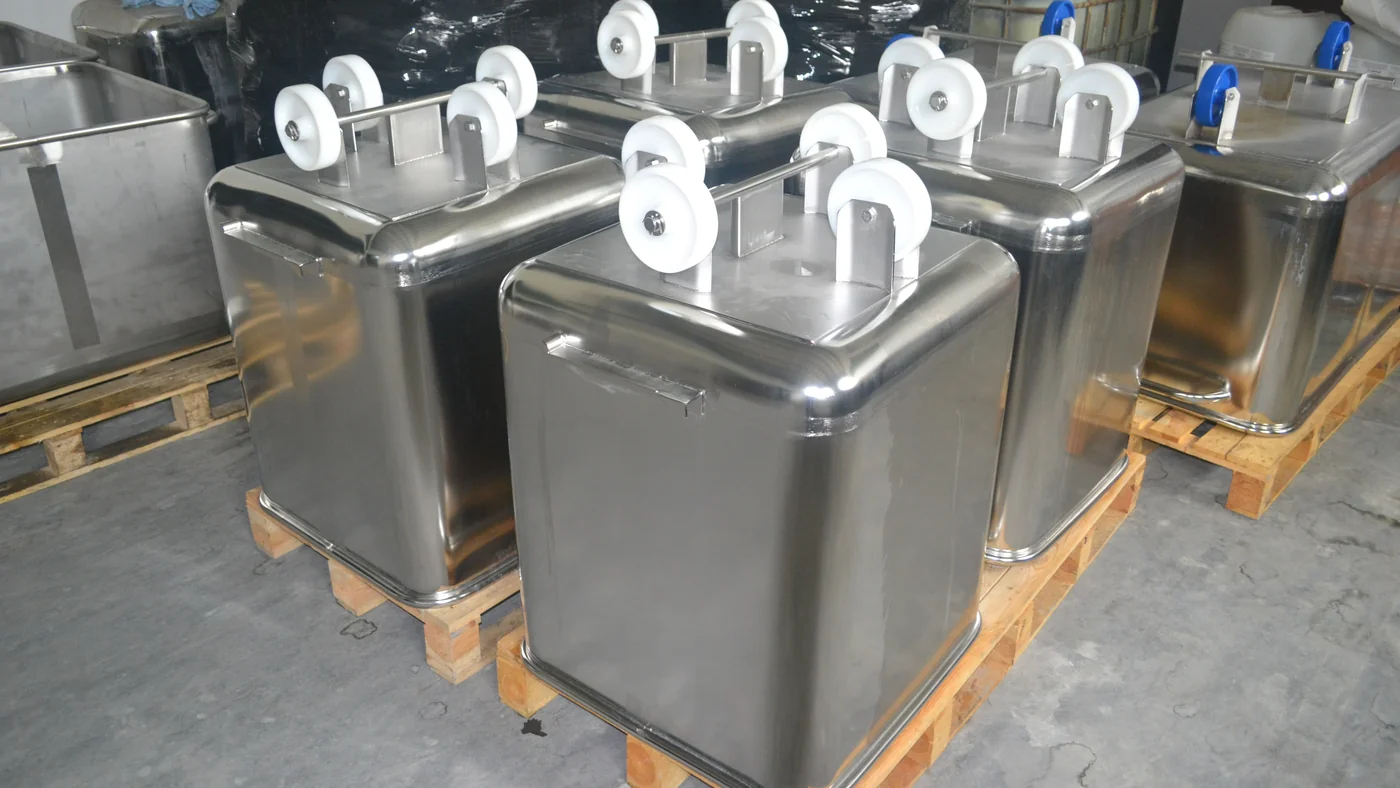
Why does stainless steel rust in a meat plant? Salt, chlorine and cleaning agents — how to prevent and remove corrosion
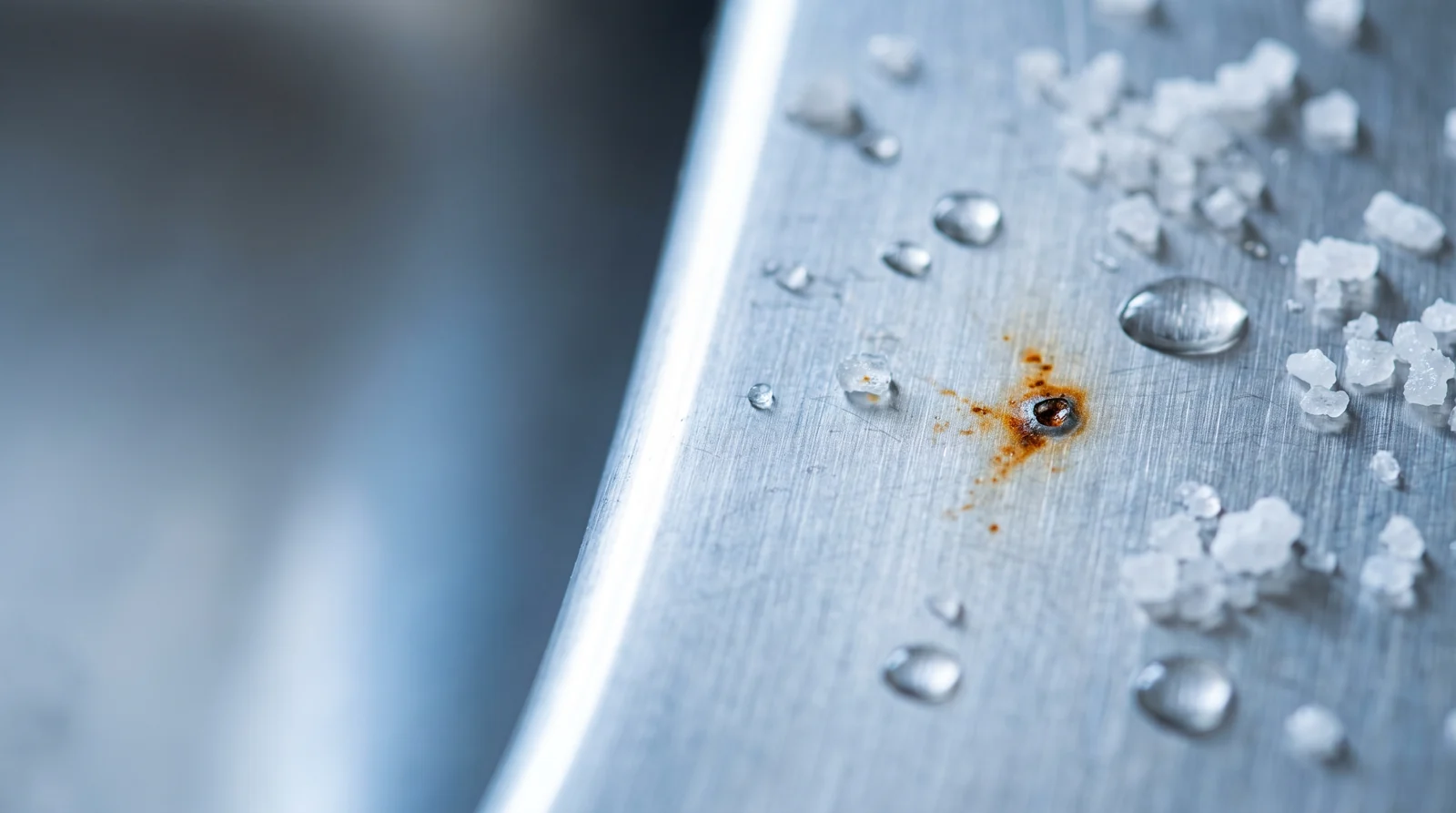
A complaint that “the stainless steel is rusting” almost never ends with the material being at fault. It ends with brine left overnight, hydrochloric acid used on limescale, or a wire brush. This article shows what really happens on the surface of steel in a meat plant — and how to stop it before a stain turns into a pit.
Contents
- Stainless does not mean indestructible — how steel defends itself
- Five sources of rust in a meat plant
- Three types of corrosion — how to recognise them
- Cleaning and disinfection that do not damage steel
- 1.4301 or 1.4404 — when brine justifies the upgrade
- Design that limits the risk by itself
- When the stain is already there — removal step by step
- Checklist for the production manager
1. Stainless does not mean indestructible — how steel defends itself
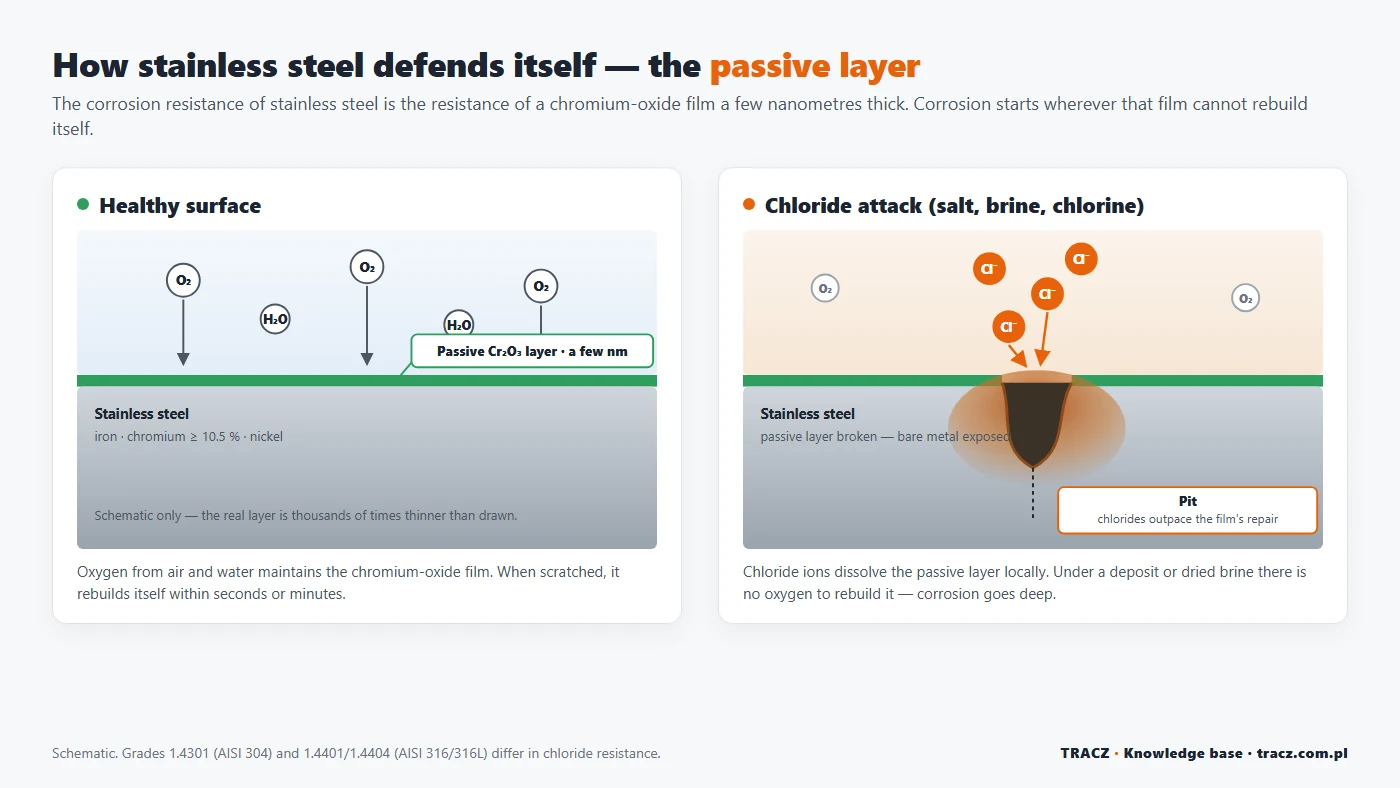
Stainless steel is not resistant because it “does not rust”. It is resistant because it rusts in a controlled way. The chromium it contains — at least 10.5 %, and considerably more in the grades used in the food industry — reacts with oxygen to form a chromium-oxide film a few nanometres thick on the surface. The film is invisible, tight and, most importantly, self-healing: when scratched, it rebuilds itself within seconds or minutes, as long as oxygen is available.
The entire corrosion resistance of stainless steel is therefore the resistance of this one layer. Corrosion always starts in the same place: wherever the passive layer cannot rebuild itself. Under a deposit, in a crevice with no access to oxygen, or where chloride ions punch holes in it faster than oxygen can patch them.
“Stainless” or “acid-resistant”? On the shop floor in Poland, “acid-resistant steel” usually means a molybdenum-alloyed grade (1.4401/1.4404, AISI 316/316L), while “stainless” means grade 1.4301 (AISI 304). Technically both are stainless steels from the same family; what separates them is chloride resistance. That is why at TRACZ we say “stainless steel” and always quote the grade number — the only precise way to put it. More on designations: 1.4301 or AISI 304 — decoding steel grades.
2. Five sources of rust in a meat plant
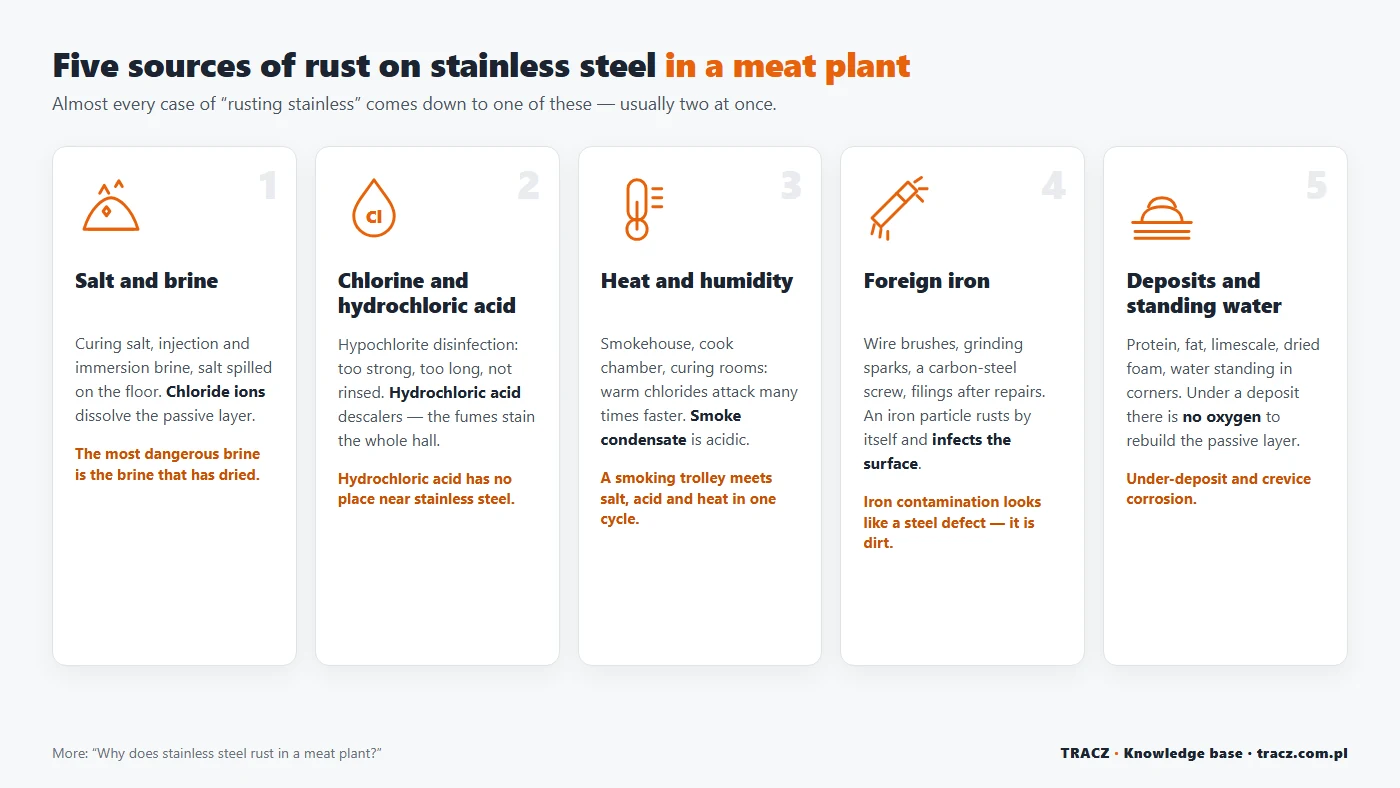
In a meat processing plant, steel works in one of the harshest environments in the whole food industry. Not because of a single factor — because of several factors overlapping. Here are the five sources behind almost every case of “rusting stainless” we have seen over the years.
Salt and brine
Curing salt, injection and immersion brine, salt spilled on the floor and carried up with water during washing. Chloride ions are enemy number one of the passive layer: they dissolve it locally and open a path to the metal. The most dangerous brine is not the brine in the vat — it is the brine that has dried. As it evaporates, the salt concentration climbs to saturation, and on a warm surface the whole process accelerates many times over.
Chlorine in disinfection and hydrochloric acid
Sodium hypochlorite products are effective disinfectants, but they contain active chlorine. Too high a concentration, too long a contact time, no rinsing, or the product drying on the surface — each of these mistakes leaves a mark. Hydrochloric acid used for descaling is a category of its own: its fumes settle on everything within several metres and can stain an entire hall in a single night. Hydrochloric acid has no business anywhere near stainless steel.
Heat and humidity
In the smokehouse, the cook chamber and the curing room, chlorides act at elevated temperature, which multiplies their aggressiveness. Above roughly 50–60 °C, austenitic stainless steels additionally become susceptible to chloride stress corrosion cracking. On top of that, smoke condensate is acidic (organic acids, phenols), and brine dripping from the product settles on sticks and frames. A smoking trolley meets salt, acid, moisture and heat all at once in a single cycle.
Foreign iron
A carbon-steel wire brush, sparks from a grinder working a few metres away, a plain-steel screw, filings left after repairs, iron in water from an old installation. A particle of ordinary iron sitting on stainless steel rusts by itself, and beneath it a micro-cell forms that attacks the base metal. The result is rust specks that look like a material defect but are contamination from outside. In the trade it is known as iron contamination.
Deposits and standing water
Residues of protein and fat, limescale from hard water, dried foam, water standing in corners or under a gasket. There is no oxygen under a deposit, so the passive layer cannot rebuild — under-deposit and crevice corrosion set in. Contact with another metal belongs to this group too: aluminium or galvanised parts left in brine on stainless steel form a galvanic cell.
3. Three types of corrosion — how to recognise them
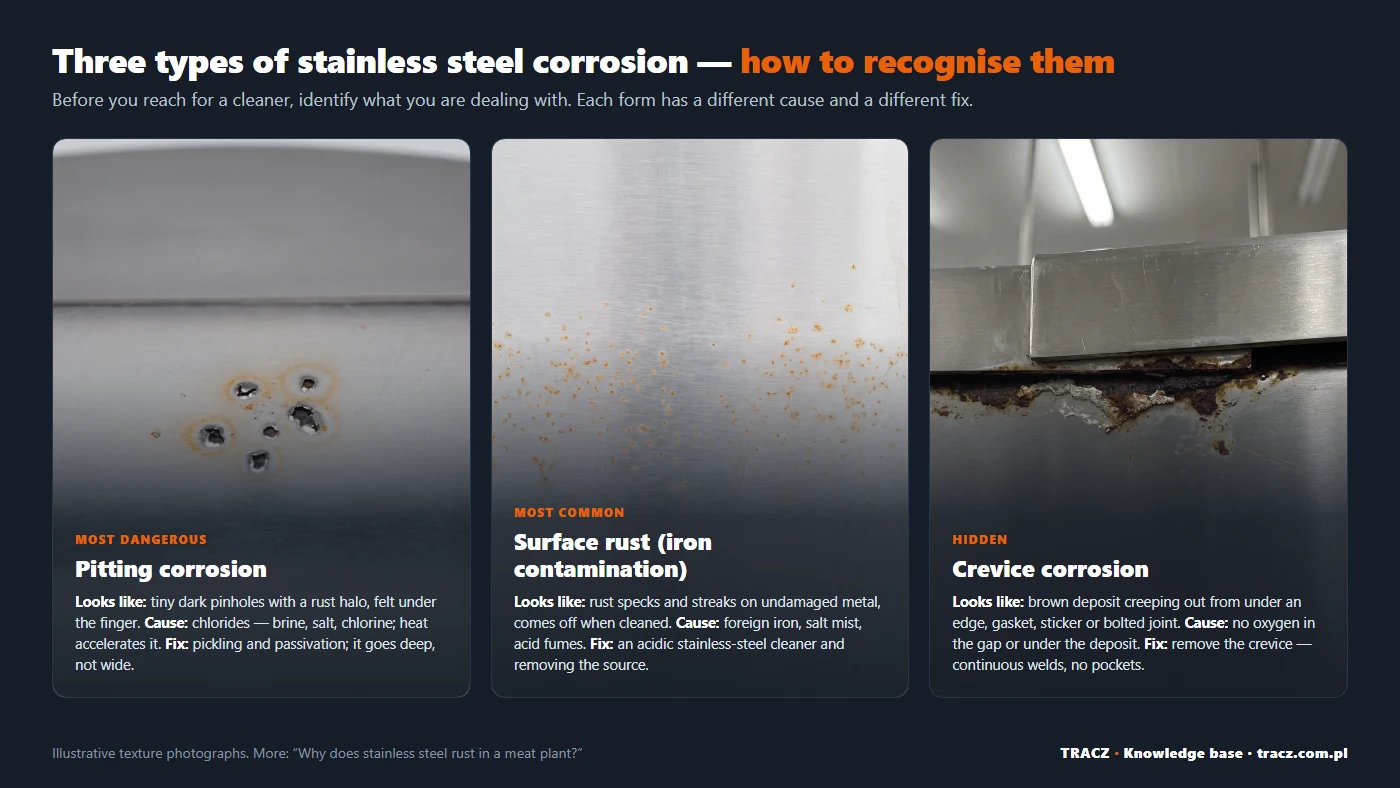
Before you reach for a cleaner, identify what you are dealing with. The three most common forms of corrosion on meat-plant equipment differ in appearance, cause and remedy.
| Type | What it looks like | Where it comes from | What to do |
|---|---|---|---|
| Pitting | Tiny dark pinholes with a rust halo; felt under the finger | Chlorides: brine, salt, chlorine-based agents; accelerated by heat | Pickling and passivation; deep pits — grinding with tools reserved for stainless steel, then passivation |
| Surface rust (iron contamination) | Rust specks and streaks on undamaged metal; come off when cleaned | Foreign iron, salt mist, acid fumes | Acidic stainless-steel cleaner or passivating paste; remove the source of iron |
| Crevice corrosion | Brown deposit creeping out from under an edge, gasket, sticker or bolted joint | No oxygen under the deposit or in the gap | Remove the deposit and the cause of the crevice; in design — continuous welds, no pockets |
Of the three, pitting is the most dangerous because it goes deep rather than wide. The surface may look almost clean while, underneath, a cavity keeps growing until one day it breaks through the wall of a vat. Surface rust, on the other hand, is harmless in itself — but left for weeks it becomes the starting point for pits.
4. Cleaning and disinfection that do not damage steel
A cleaning procedure in a meat plant has two goals at once: microbiological safety and preservation of the surface. A well-designed procedure supports HACCP and protects the steel at the same time. A poorly designed one produces corrosion by itself. The sequence that works:
- Pre-rinse with lukewarm water, not hot — hot water coagulates protein and bakes it onto the steel.
- Alkaline foam cleaner — dissolves fat and protein; safe for stainless steel.
- Thorough rinse — cleaner residues weaken disinfection and stay on the surface.
- Disinfection at the concentration and contact time given in the product's technical data sheet — no more and no longer.
- Rinse with potable water — mandatory after chlorine-based products and quaternary ammonium compounds.
- Drain and dry — no standing water in corners, on shelves or in the bottom of vats.
| Allowed | Avoid |
|---|---|
| Alkaline agents for fat and protein | Hydrochloric acid in any form — even used a few metres away |
| Acidic descalers based on phosphoric, nitric or citric acid | Hypochlorite dosed “by eye” and left to dry |
| Nylon pads, plastic or stainless-steel brushes | Chlorine disinfection on a hot surface |
| Water low in chlorides; with hard water — regular descaling with a safe acid | Steel wool, scouring pads, carbon-steel brushes |
| Separate tools for stainless steel and for floors | Tools that have previously touched ordinary steel |
| Pressure washing at a safe distance from wheel bearings | Brine and chemicals left on the surface overnight |
One rule that solves most problems: nothing that contains chlorides or chlorine may ever dry on stainless steel. Not brine, not disinfectant, not the water from washing a floor that had salt on it.
5. 1.4301 or 1.4404 — when brine justifies the upgrade
Grade 1.4301 (AISI 304), alloyed with chromium and nickel, is the standard in the food industry and in our catalogue. In the normal operation of a meat plant it is entirely sufficient: stuffing trolleys, smoking trolleys, tables, racks and trolley-vats for transporting raw material made from 1.4301 serve for years, provided contact with brine is short and ends with rinsing.
Grades 1.4401 and 1.4404 (AISI 316 and 316L) additionally contain molybdenum. It is molybdenum that raises resistance to chloride-induced pitting. Paying extra for a molybdenum grade makes sense when:
- brine stands in the vessel for hours or days — immersion curing vats, brine tanks, injection systems;
- the salt concentration is high and the process temperature elevated;
- chlorine disinfection is frequent and intensive;
- the plant is in a coastal area, where chlorides are also in the air.
On the other hand, molybdenum is no substitute for hygiene. A 1.4404 vat in which brine dries out over the weekend will get pits too — just later. That is why at TRACZ we ask about the process first and the grade second. Our curing vats and trolley-vats are made as standard from 1.4301 and electropolished, while stuffing trolleys are available in 1.4301 or 1.4401. If your curing process calls for a molybdenum grade, we will select it together with you.
6. Design that limits the risk by itself
A large share of corrosion problems is decided not at the cleaning stage but at the design and manufacturing stage. A well-built trolley or vat simply has no places where corrosion could begin.
- Continuous, ground and passivated welds. Welding destroys the passive layer in the heat-affected zone; the heat tint must be removed and passivity restored, otherwise the weld becomes the first place to rust. Intermittent welds leave crevices — unacceptable in hygienic design.
- Electropolishing. Electrochemical smoothing removes the micro-roughness in which deposits lodge and enriches the surface layer with chromium — the passive layer becomes thicker and more stable. That is why our vats, trolley-vats and stuffing trolleys are electropolished.
- Rounded corners and bend radii instead of sharp angles — no dead zones where water stands.
- No pockets or crevices: closed profiles, fully welded joints, no overlapping plates.
- Wheels, axles and fasteners in stainless steel or plastics. A single carbon-steel bolt can “infect” a whole wheel with rust.
- Drainage: sloped bottoms, outlets, drain holes — nothing may stand after washing.
- No stickers or labels on working surfaces — there is always a crevice under a sticker.
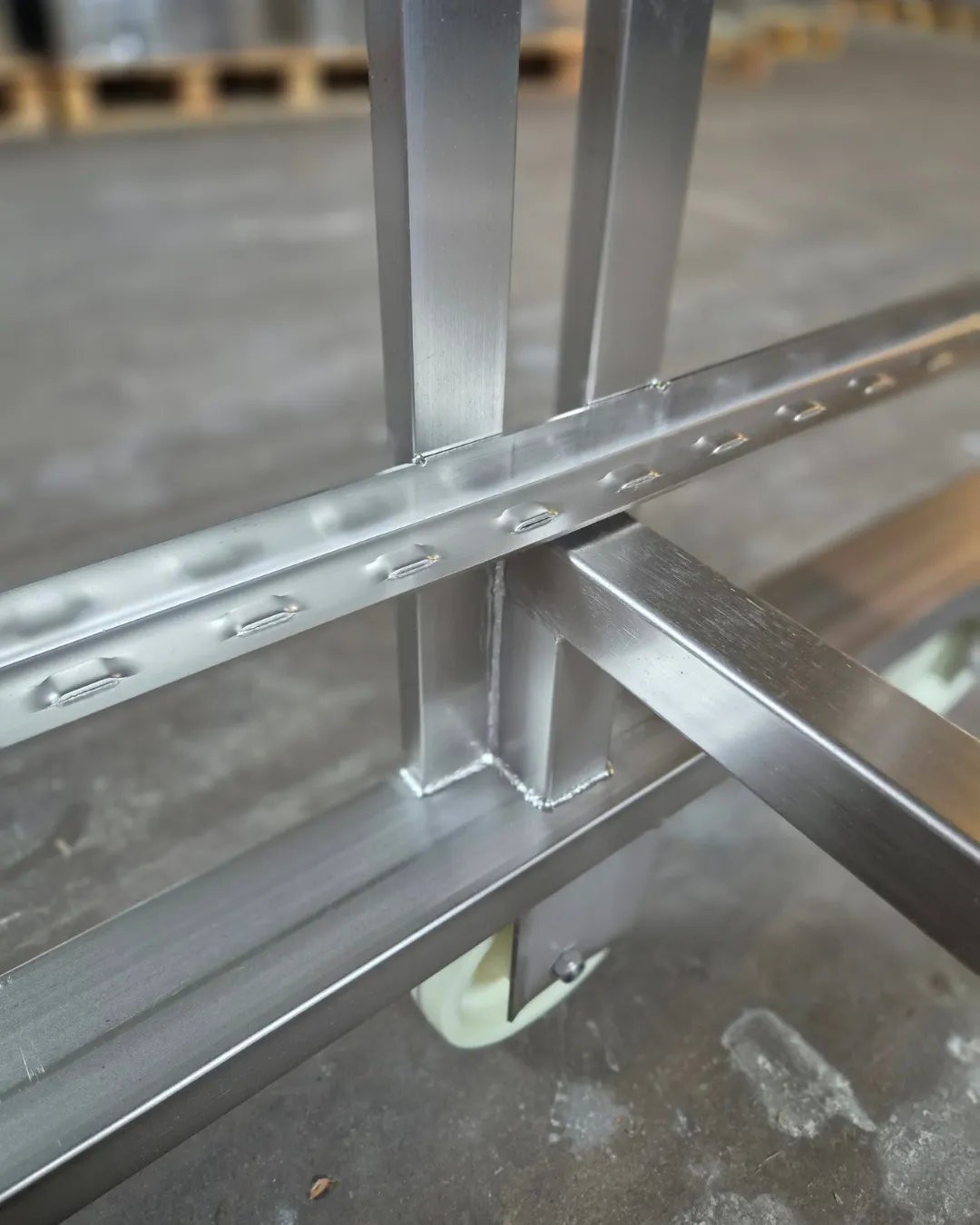
How this looks in practice on our shop floor is shown in the articles The Path to Perfect Hygiene and Anatomy of Perfection. The equipment discussed in this article:
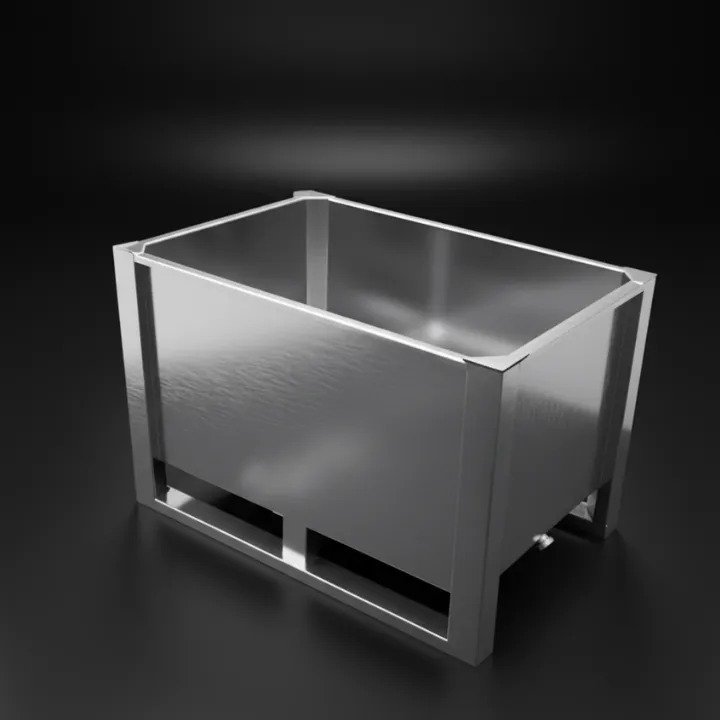 Curing vat (container box) 600 L
  Trolley-vat 450 L
 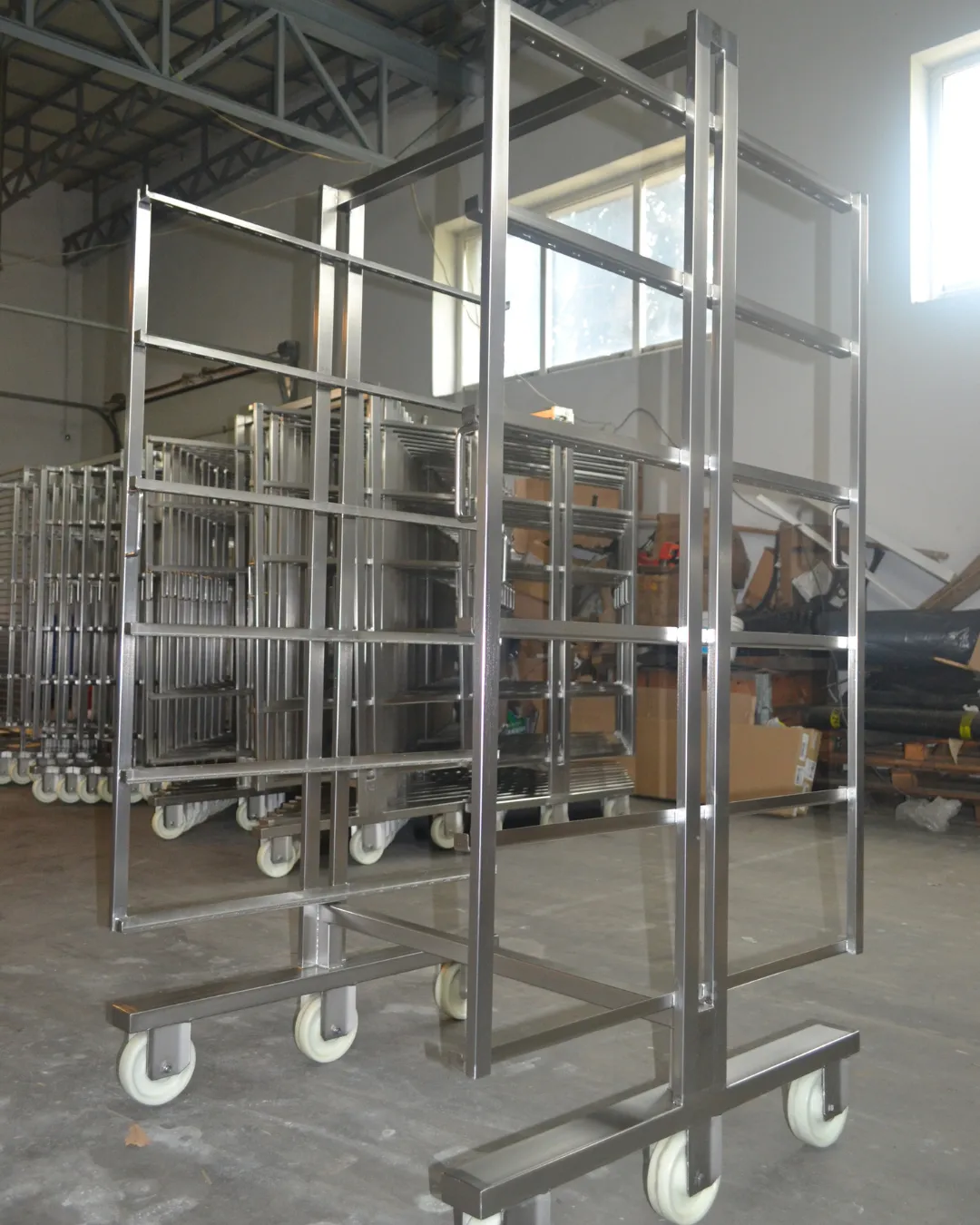 Smoking trolley type H
 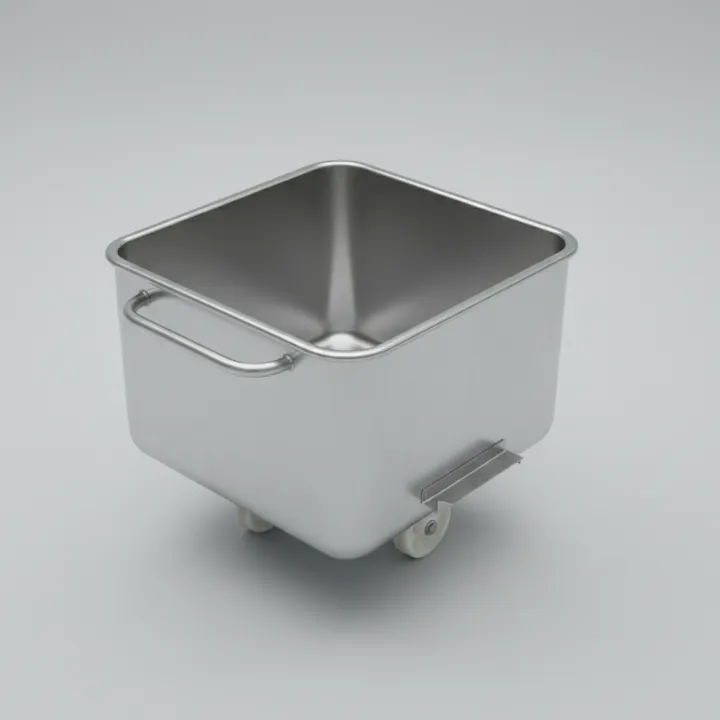 Stuffing trolley — Euro tub 200 L
 7. When the stain is already there — removal step by step
- Identify what you are dealing with. Wipe the spot with a damp nylon pad. If the stain comes off — it is surface rust. If a dark point remains that you can feel under your finger — it is a pit.
- Light surface rust: an acidic cleaner intended for stainless steel (citric or phosphoric acid based) or a stainless-steel cleaning paste, a nylon pad, working along the grain of the brushed surface. Rinse and dry.
- Extensive rust, after sparks or acid fumes: a pickling and passivating paste for stainless steel. These are professional products: gloves, goggles, ventilation, generous rinsing and neutralisation as per the safety data sheet. This is never done in the production area during operation.
- Pits: pickling and passivation stop the process. Deep pits require grinding — only with tools that have never touched ordinary steel — followed by re-passivation. A pit that has gone through the wall means a welding repair by the manufacturer.
- After any mechanical intervention (grinding, repair welding) the surface is “bare” — passivate it before the equipment goes back into production.
- Remove the cause. Otherwise the stain will be back in the same place within a month: find the source of iron, change the disinfection procedure, eliminate standing water.
What not to do: do not grind with a wire brush or steel wool, do not use hydrochloric acid “because it works fast”, do not paint or lacquer stainless steel, do not leave it “because it is only a spot”.
Damaged equipment can be repaired. As part of our welding services we carry out repair welding and surface finishing of stainless steel components.
8. Checklist for the production manager
- Brine and salt never dry on steel — rinse after every contact.
- Hydrochloric acid does not exist in the plant; for limescale — phosphoric, nitric or citric acid.
- Chlorine disinfection: concentration and time from the data sheet, rinse with potable water, never on a hot surface.
- Separate tools for stainless steel: nylon pads, plastic brushes, no wire brushes.
- Grinding and welding of ordinary steel — outside the area with stainless equipment, or with the equipment covered.
- Everything drains after washing: no standing water in vats, on shelves, in corners.
- Bolts, screws, wheels and axles replaced only with stainless steel or plastic parts.
- Curing vats and brine tanks: grade selected for the concentration and contact time.
- Monthly inspection: specks and streaks removed immediately, pits reported for repair.
- Stickers and labels — never on working surfaces.
Not sure which grade to choose for a curing vat, or how to prepare equipment for intensive washing? Write to us — we will advise based on your process, not on a catalogue.
P.P.H.U. TRACZ — Engineering tailored to your needs. Since 1987.