Sharp corner or radius? Hygienic design of stainless steel tubs
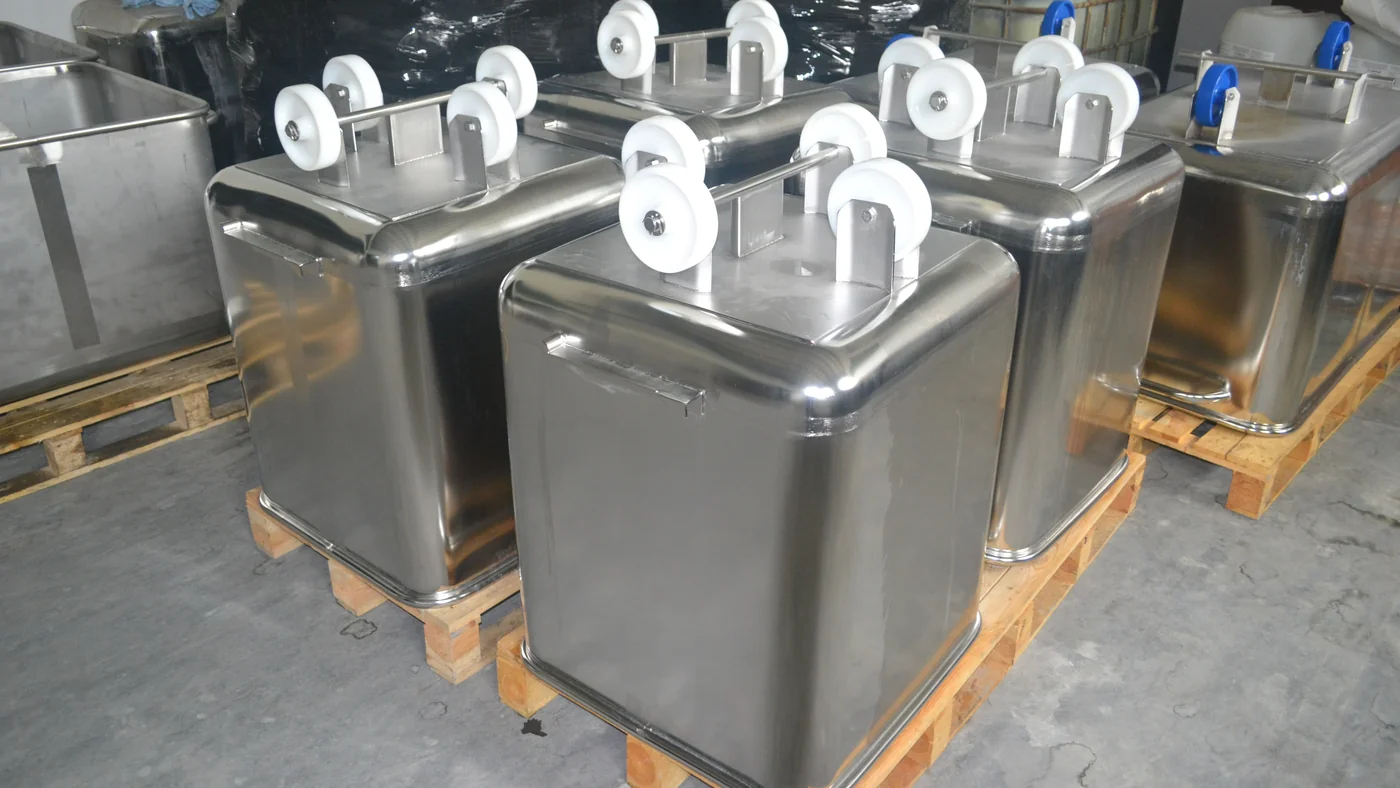
In a catalogue photo, two stainless steel tubs look almost identical. The difference only shows during cleaning — in the corner the water jet never reaches. This article explains why a radiused corner is a matter of hygiene, not looks, and what to check in a tub before it reaches your production floor.
Contents
- What happens in a corner during cleaning
- What hygienic design principles say
- The radius is only half of it — weld, drain and rim
- Where it matters most: curing and brine
- How to check a tub before you buy — 6 points
- Frequently asked questions
1. What happens in a corner during cleaning
Cleaning a tub in a meat plant usually follows the same sequence: pre-rinse, detergent, scrubbing, final rinse. Every step assumes that water and detergent reach every point of the surface and run off it, taking the soil with them.
In a sharp 90° corner that assumption fails. The flow running down the wall reaches the corner and turns before the wall ends — it passes over the apex itself. A dead zone forms in the corner, where water barely moves. Fat, protein and salt residue stays there. A straight-bristle brush cannot reach the apex, and the corner is the last place to dry.
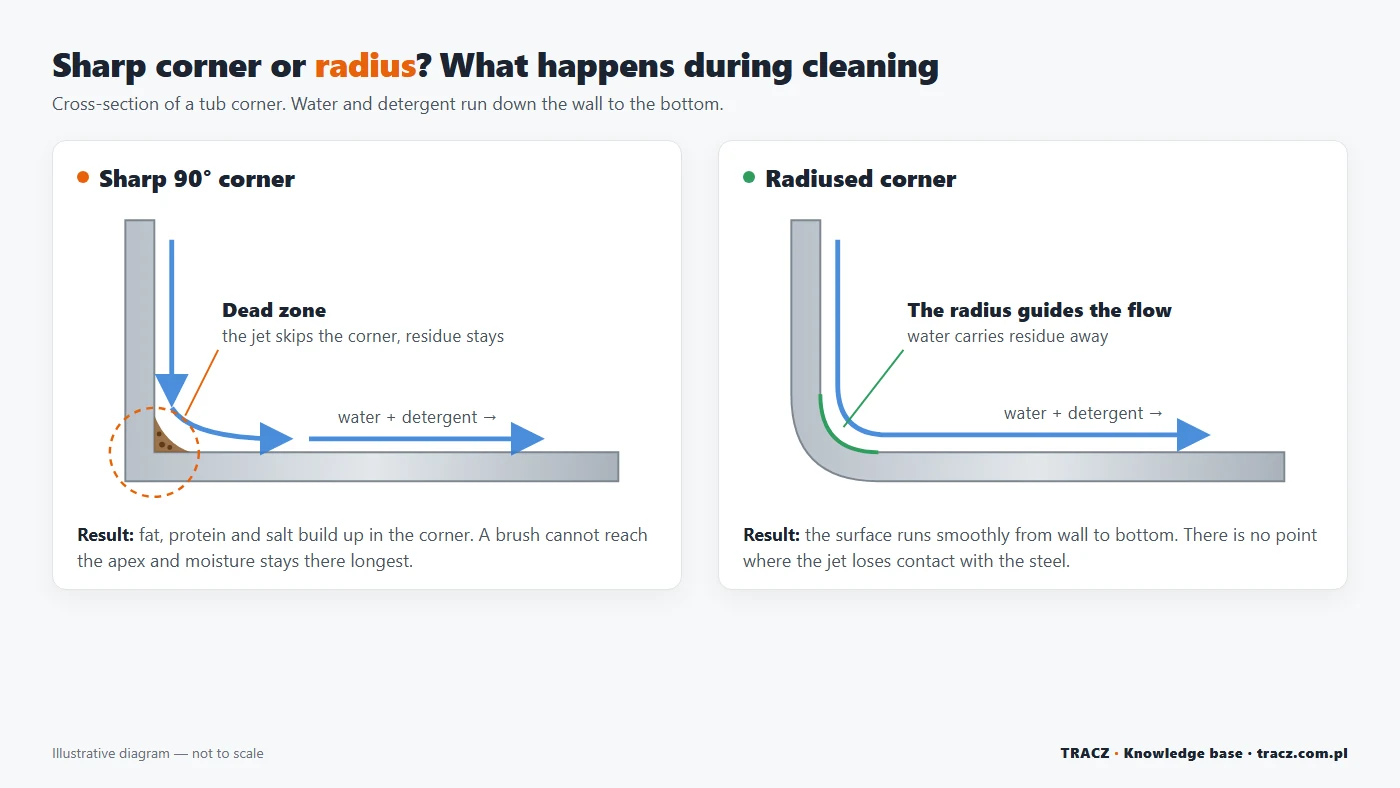
A radiused corner behaves differently. The surface runs from wall to bottom in a smooth curve, so the flow never loses contact with the steel and carries residue away. A sponge or brush reaches everywhere, and water has nowhere to stand.
Damp, hard-to-reach crevices are where microorganisms have the best chance of surviving cleaning. That is why hygienic design starts by eliminating such places altogether — not by using stronger chemicals.
2. What hygienic design principles say
The principles of designing equipment that is easy to keep clean are set out by the EHEDG (European Hygienic Engineering & Design Group) in its guidelines. Hygiene requirements for food processing machinery are covered by EN 1672-2, and general criteria by EN ISO 14159. They all start from the same idea: a food-contact surface must be smooth, free of gaps and crevices, easy to clean and self-draining.
This leads to specific design choices:
- Radiused internal corners. In industry practice a radius of about 3 mm is treated as the minimum — and the larger, the easier to clean.
- A smooth surface. The usual reference value for food-contact surfaces is a roughness of Ra ≤ 0.8 µm.
- Self-draining. A bottom sloping to the drain, with no flat ledges or pockets where water stands.
- Joints without gaps. Continuous welds, with no overlaps, rivets or exposed threads in the product zone.
The standards divide equipment into zones: the food zone (product contact), the splash zone and the non-food zone. Requirements are strictest in the first — and a curing tub or trough trolley is almost entirely food zone. Exact values depend on the type of equipment; the current texts of the standards are always binding.
3. The radius is only half of it — weld, drain and rim
A radiused corner achieves nothing if a gap is left next to it. In practice, a hygienic tub is several details working together.
Continuous, ground welds
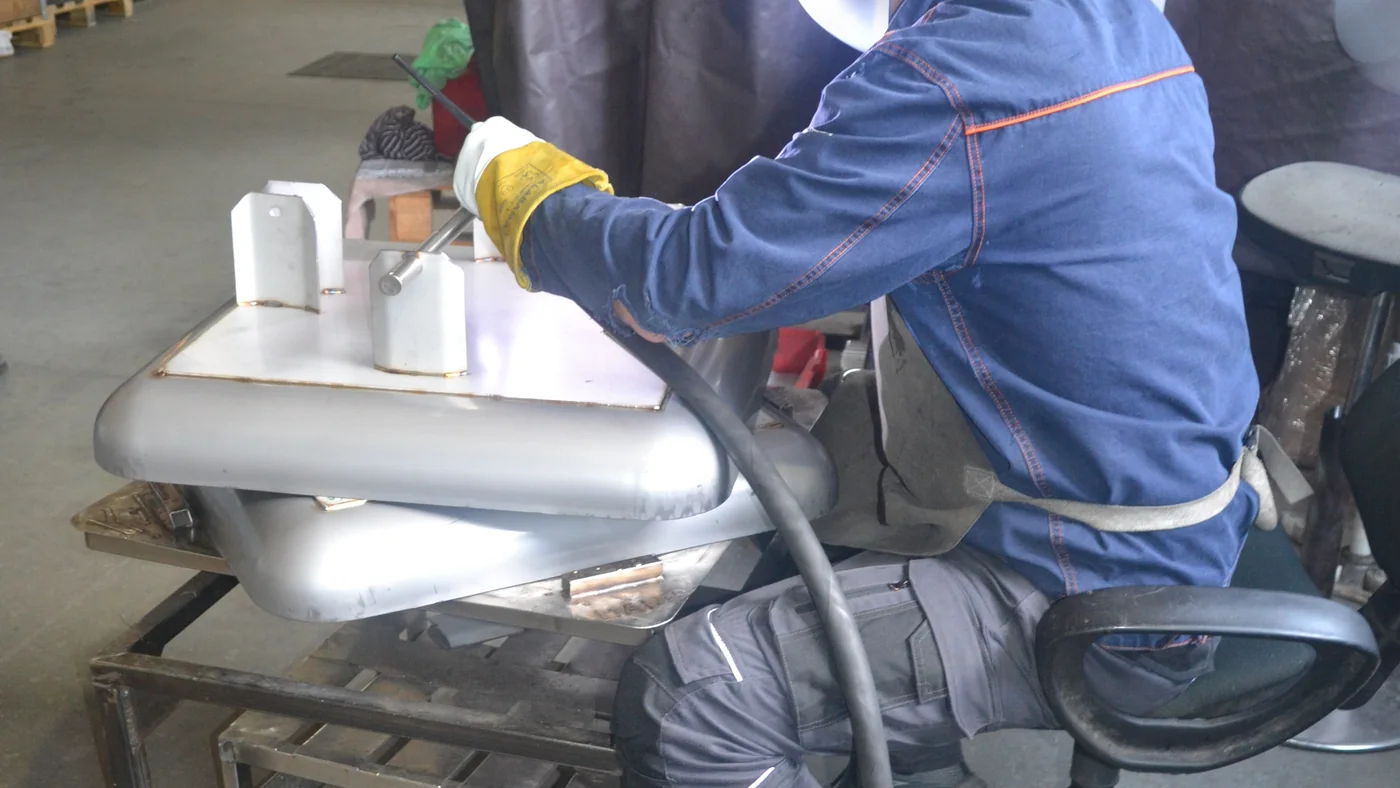
A weld in the product zone must be continuous — spot or stitch welding leaves gaps between the welds where soil collects. The weld face is ground smooth so there is no step and no pores.
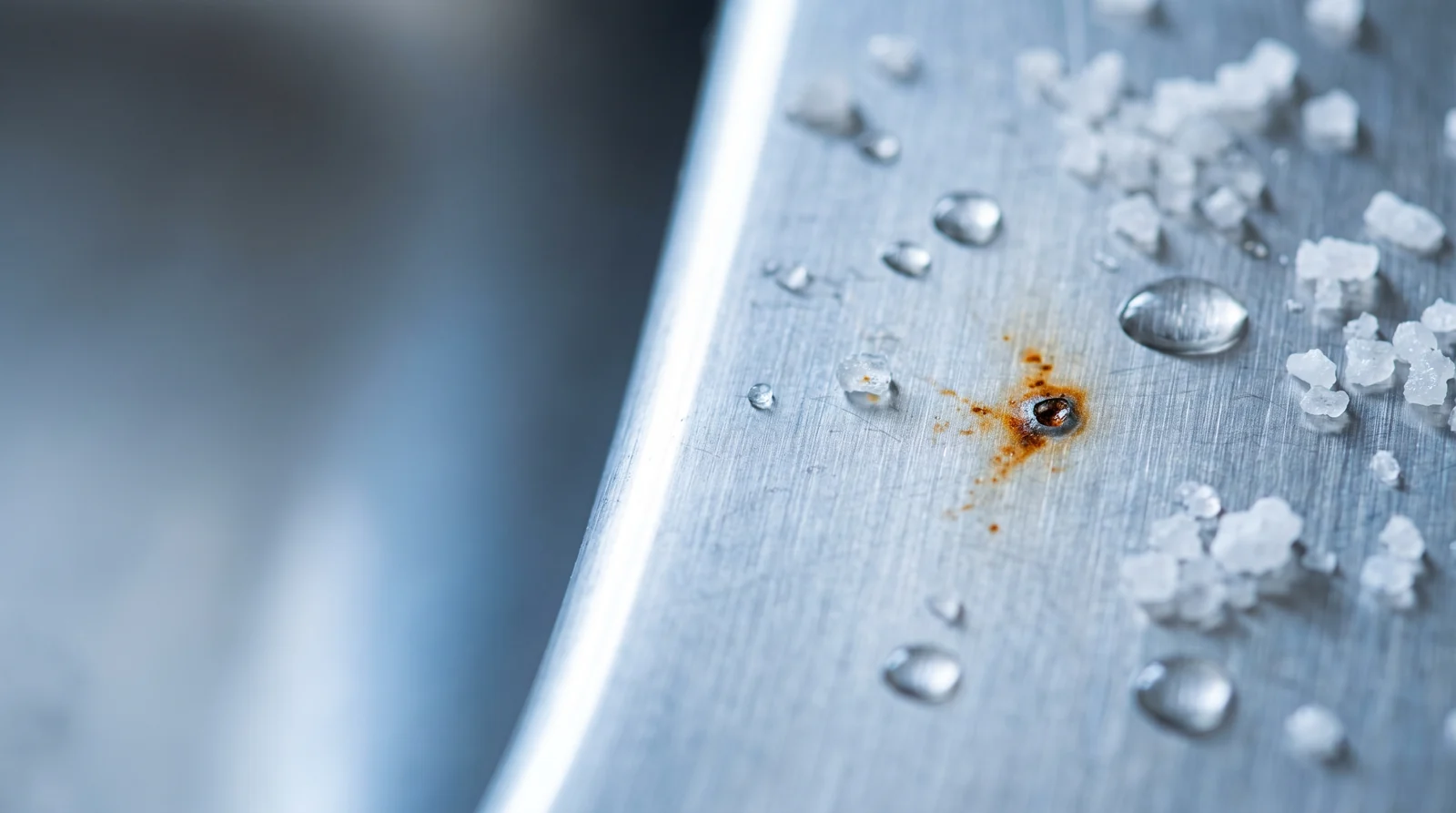
There is one more thing that is easy to forget: welding destroys the protective layer of stainless steel at the weld. You can see it as heat tint. Unless it is removed and the surface's resistance restored, the weld will be the first place where rust appears. More in the article Why does stainless steel rust in a meat plant.
Drain at the lowest point
After cleaning, water should leave on its own. A drain at the lowest point of the bottom, and a bottom shaped without hollows, keep the tub from starting the next shift with a puddle of the previous one's residue.
A rim without a gap
The top edge of a tub is reinforced — by folding the sheet or with a bar. Such a rim must be either fully closed or open enough for the water jet to reach inside. The worst option is the in-between one: a narrow gap that lets water and residue in, but nothing that would flush them out.
A smooth surface
Electropolishing smooths the steel surface and makes cleaning easier, but it does not replace good geometry. A polished sharp corner is still a sharp corner — the jet skips it just the same.
4. Where it matters most: curing and brine
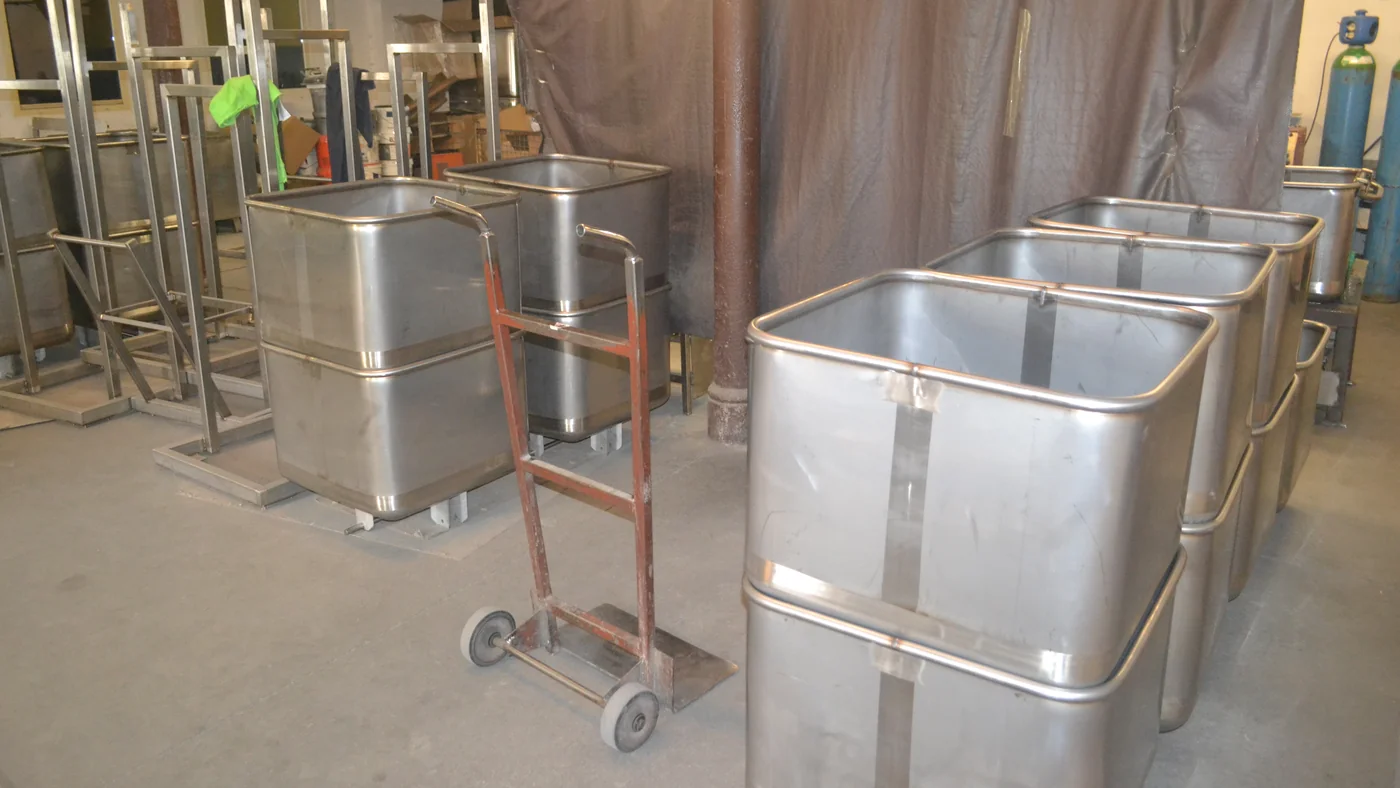
In a curing tub, residue in the corner is not only a microbiological problem. Brine contains chlorides, which attack the protective layer of stainless steel. Under the deposit there is no oxygen, so the layer cannot rebuild — and crevice corrosion starts right there. A corner that cleans well is therefore also a tub that lasts longer.
The same applies to trough trolleys and containers used to move raw material, and to stuffing trolleys — whose dimensions and shape are set by DIN 9797, covered in our guide to stuffing trolleys.
5. How to check a tub before you buy — 6 points
All of these can be checked on the shop floor or at delivery — no lab needed, just a finger, a torch and the manufacturer's documentation.
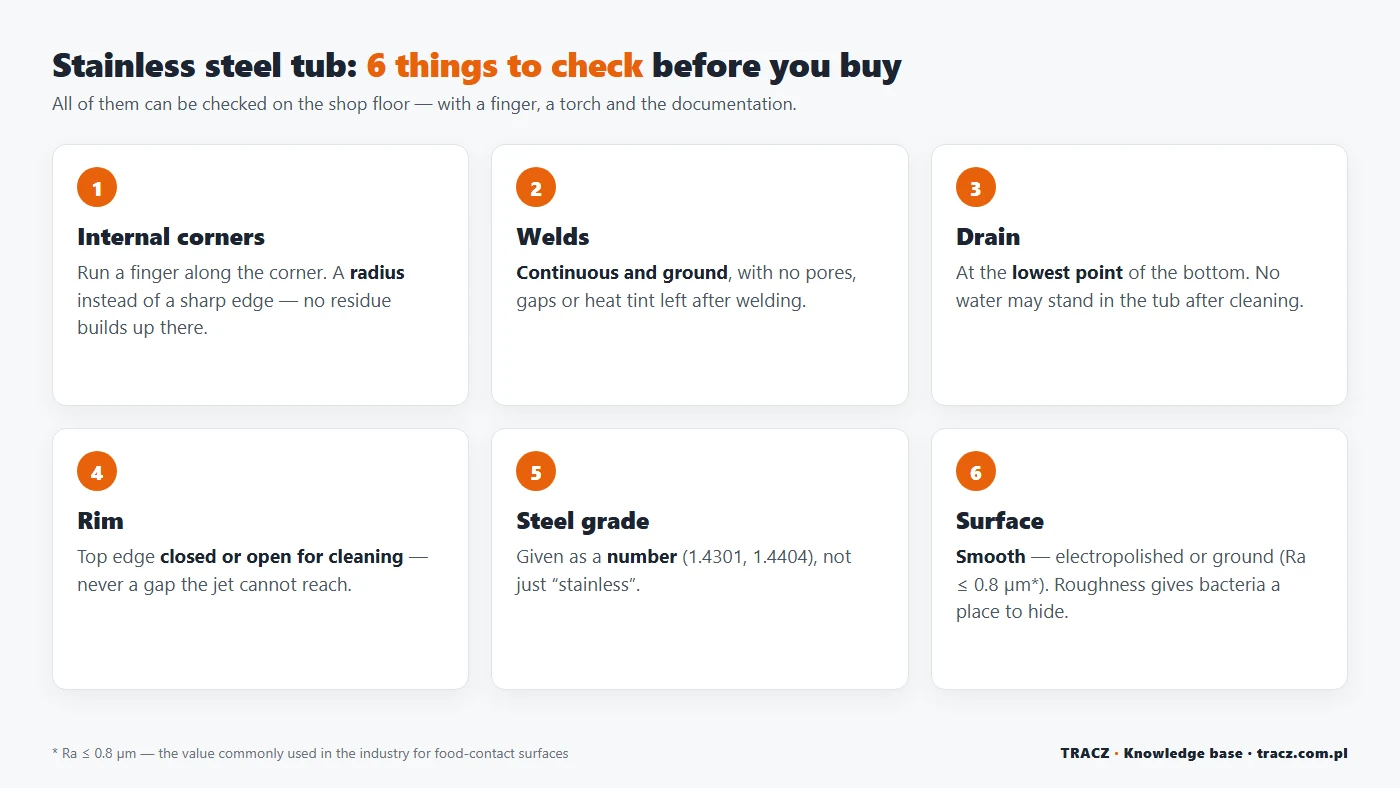
- Internal corners. Run a finger along the corner — you should feel a curve, not a sharp edge.
- Welds. Continuous and ground, with no pores, gaps or heat tint.
- Drain. At the lowest point of the bottom; no water stands in the tub after cleaning.
- Rim. Closed or open for cleaning — no narrow gap.
- Steel grade. Given as a number (e.g. 1.4301 or 1.4404), not just “stainless”.
- Surface. Smooth to the touch — electropolished or ground.
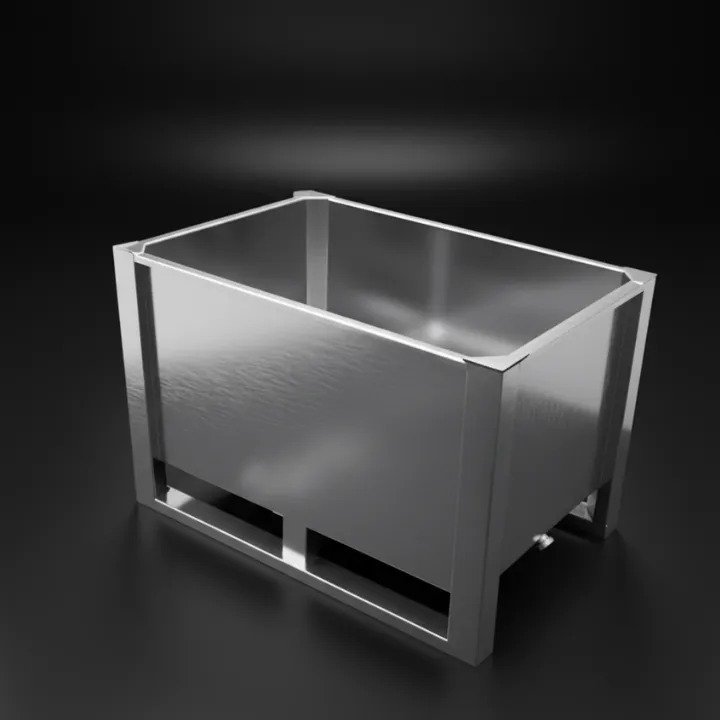
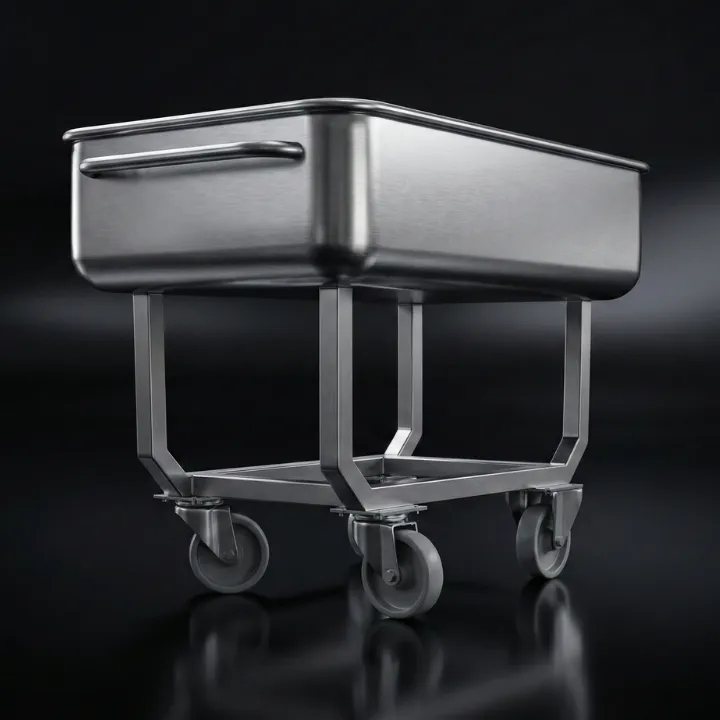
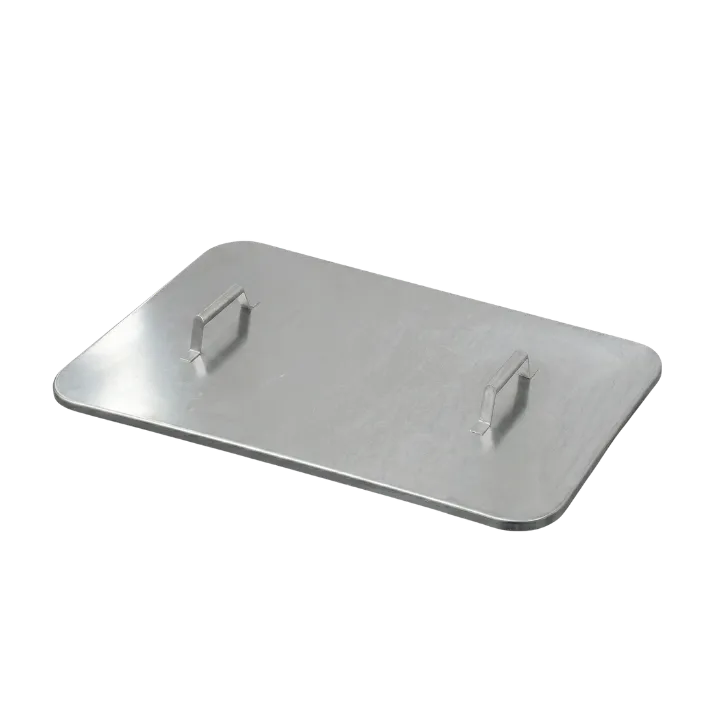
The tubs and trough trolleys in our catalogue are made of stainless steel, electropolished, and their corners are radiused. Examples:

6. Frequently asked questions
What corner radius is enough?
In industry practice a radius of about 3 mm is considered the minimum, and a larger one is easier still to clean. For a custom tub, agree the radius with the manufacturer together with the dimensions and steel grade.
Does electropolishing replace a radiused corner?
No. Electropolishing smooths the surface but does not change the geometry. In a polished sharp corner the water jet still skips the apex. The best result comes from both together: a radius and a smooth surface.
Can a tub with sharp corners or leaking welds be fixed?
Sometimes — it depends on the design. Welds can be completed and ground, and the surface's resistance restored. Changing the corner geometry is harder, and replacing the tub may make more sense. Our welding services include repairs and modifications of stainless steel equipment; every case is quoted individually, usually from photos.
Need a tub in a non-standard size, or want to check whether your current equipment meets hygiene requirements? Contact us — we will advise based on your process.
P.P.H.U. TRACZ — Engineering tailored to your needs. Since 1987.